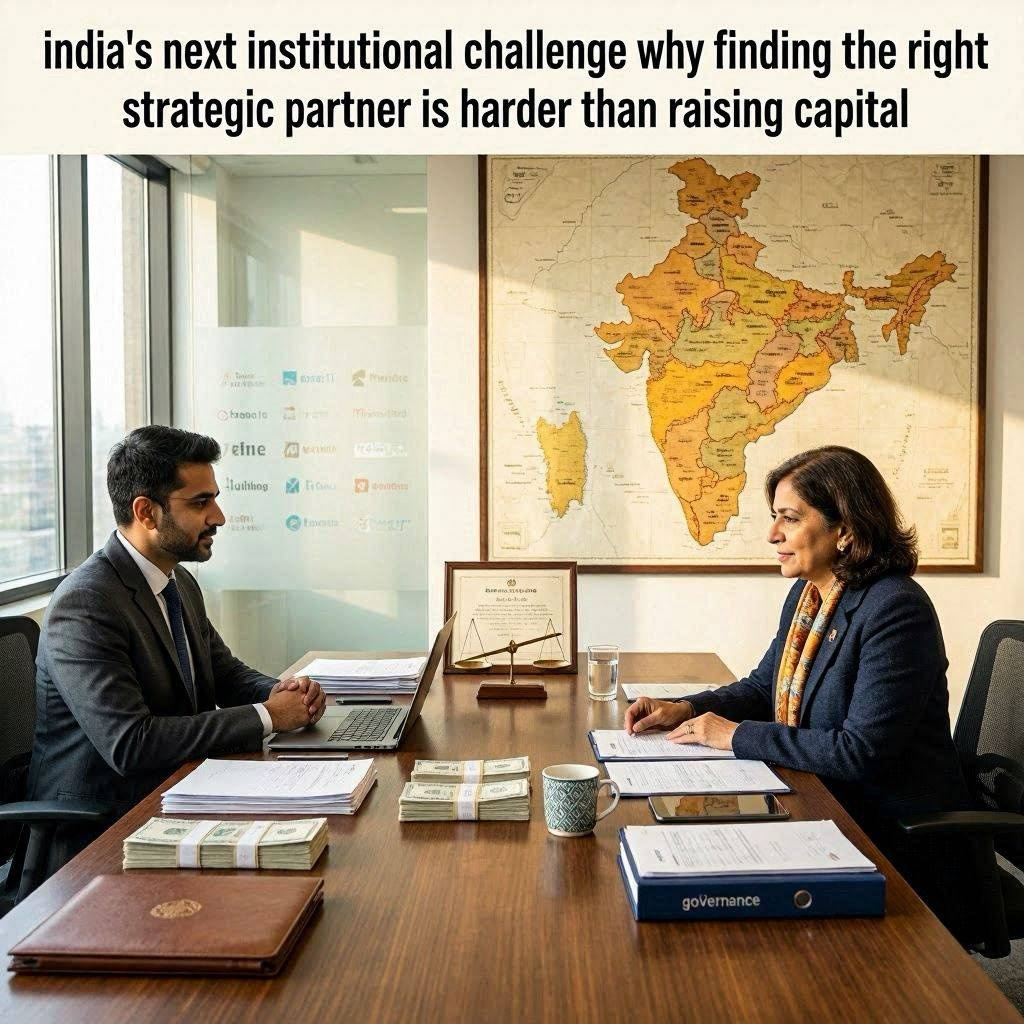
India’s Next Institutional Challenge: Why Finding the Right Strategic Partner Is Harder Than Raising Capital
An Analytical Feature on the Emerging Need for a Scientific Strategic Partner Search Framework
As India’s economy continues its rapid expansion across education, healthcare, manufacturing, infrastructure, technology, and social enterprises, institutional leaders are discovering an unexpected reality: raising capital is no longer the biggest challenge. Identifying a strategic partner who can combine investment capability, governance expertise, operational leadership, and long-term institutional commitment has become significantly more difficult.
Industry research on strategic alliances consistently shows that partnership failures are more often caused by poor partner selection, governance gaps, strategic misalignment, and ineffective lifecycle management than by funding shortages alone. Structured approaches emphasize partner qualification, governance design, trust building, performance measurement, and ongoing partnership management as essential success factors.
India’s Strategic Partner Gap
Across India, promoters, trustees, boards, family businesses, universities, hospitals, charitable trusts, and corporate groups increasingly seek partners who can contribute not only financial resources but also strategic direction, institutional credibility, innovation, and global networks.
However, such multi-dimensional partners remain relatively uncommon.
Major Challenges Facing Indian Institutions
1. Governance Deficit
Many institutions continue to rely heavily on founder-driven or trustee-centric decision-making, limiting professional governance and succession planning.
2. Investor–Institution Misalignment
Promoters often seek long-term institution builders, while many investors prioritize defined financial returns, creating expectation gaps.
3. Financial Transparency
Weak reporting systems, inconsistent disclosures, and limited governance practices can reduce investor confidence.
4. Regulatory Complexity
Education, healthcare, charitable trusts, and infrastructure sectors each operate under distinct regulatory frameworks, increasing due diligence requirements.
5. Leadership Continuity
Institutions frequently struggle to identify strategic partners capable of leading transformation over decades rather than funding isolated projects.
6. Cultural Compatibility
Differences in organisational values, decision-making styles, and governance philosophies often undermine otherwise promising partnerships.
7. Technology Readiness
Digital transformation, cybersecurity, artificial intelligence, and data governance have become central evaluation criteria for strategic investors.
8. Reputation Risk
Institutional reputation, compliance history, litigation exposure, and stakeholder trust increasingly influence partnership decisions.
9. ESG and Sustainability Expectations
Environmental, social, and governance considerations are becoming important components of institutional assessments for many long-term investors.
10. Long-Term Value Creation
Modern strategic partnerships increasingly emphasize innovation, resilience, talent development, and societal impact alongside financial performance.
Introducing the PAPR-SPS Framework
To address these challenges, this article proposes an original analytical model named the PAPR-SPS Framework (Partnership Assessment, Positioning, Readiness – Strategic Partner Search). The framework synthesizes established concepts from alliance management, governance, partner qualification, due diligence, and partnership lifecycle management found in academic research and professional practice.
Phase I — Partnership Readiness
Evaluate institutional preparedness across:
- Vision and mission alignment
- Governance maturity
- Leadership capability
- Financial transparency
- Legal compliance
- Operational stability
- Digital readiness
- ESG preparedness
Outcome: Institutional Readiness Score
Phase II — Partner Universe Mapping
Identify potential partners across:
- Corporate strategic investors
- Family offices
- Philanthropic foundations
- Educational institutions
- Healthcare groups
- Private equity
- Sovereign and pension funds
- Technology companies
- International collaborators
Phase III — Strategic Compatibility Assessment
Assess each potential partner using weighted criteria such as:
- Strategic alignment
- Governance capability
- Financial strength
- Leadership quality
- Institutional reputation
- Technology capability
- Innovation capacity
- Regulatory understanding
- Global network
- Cultural compatibility
- Social impact orientation
- Long-term commitment
Phase IV — Due Diligence Intelligence
Conduct structured assessments covering:
- Financial health
- Legal exposure
- Regulatory compliance
- Tax matters
- Intellectual property
- Cybersecurity
- ESG performance
- Reputation
- Stakeholder relationships
Phase V — Partnership Value Architecture
Define how value will be created through:
- Capital
- Knowledge transfer
- Technology
- Brand enhancement
- Market access
- Talent development
- Research collaboration
- Operational excellence
- Institutional capacity building
Phase VI — Governance Architecture
Establish:
- Board composition
- Trustee responsibilities
- Investment committee
- Academic or clinical advisory councils (where relevant)
- Decision-rights matrix
- Conflict-resolution mechanisms
- Performance review processes
- Risk oversight
Strong governance structures and clearly defined accountability are repeatedly identified as central drivers of successful long-term alliances.
Phase VII — Partnership Lifecycle Management
Monitor performance using:
- Quarterly governance reviews
- Strategic KPI dashboards
- Innovation milestones
- Financial sustainability
- Stakeholder satisfaction
- Risk monitoring
- Partnership renewal assessments
Phase VIII — Sustainability and Institutional Impact
Measure long-term outcomes including:
- Institutional growth
- Governance quality
- Research and innovation
- Student or patient outcomes (where applicable)
- Community impact
- Brand value
- National and international collaborations
Sector Applications
The framework can be adapted for:
- Corporate enterprises
- Educational trusts and universities
- Healthcare institutions and hospital systems
- Non-profit organisations
- Infrastructure projects
- Family-owned businesses
- Startups
- Research organisations
- Public-private partnerships
Looking Ahead
As India’s institutions become larger, more complex, and more globally connected, strategic partner selection is likely to evolve into a governance discipline rather than a relationship-driven exercise. Institutions that combine transparent governance, disciplined partner evaluation, and long-term collaboration frameworks are better positioned to attract strategic investors capable of supporting sustainable growth.
The PAPR-SPS Framework is intended as a structured analytical model that organizations can adapt to their own context. Its objective is to help transform partner selection from an ad hoc process into a systematic approach grounded in governance, strategic alignment, risk management, and long-term value creation.
