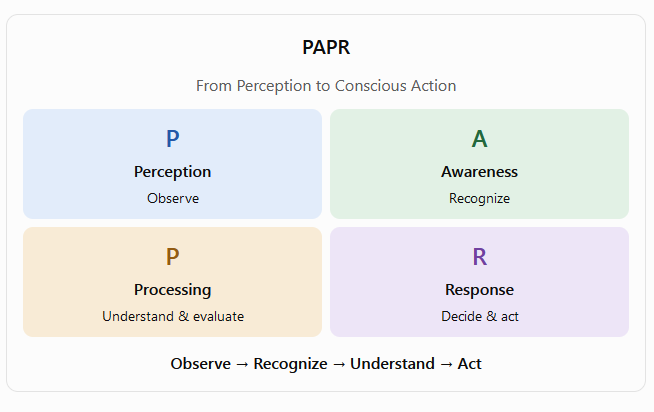
PAPR Cognitive Consciousness & Decision-Making Model
PAPR Cognitive Consciousness & Decision-Making Model: A practical framework for leadership, political consulting, organizational management, and public service.
Cognitive consciousness refers to the awareness through which a person experiences, understands, interprets, and reflects on their thoughts, perceptions, emotions, memories, and surroundings. In simple words, it is the ability to be aware of what you are experiencing, understand what you are thinking, and reflect on why you think or act in a particular way.
Better decisions begin with accurate perception, conscious awareness, objective processing, and responsible response. This is a practical explanatory model, not a universally established sequence. In reality, perception, emotion, memory, attention, and decision-making interact continuously. Although consciousness itself is a complex scientific and philosophical subject, several practical skills related to awareness and reflective thinking can be strengthened.
1. The PAPR framework
The PAPR Model work as a practical leadership framework to help individuals and organizations move from information to understanding, understanding to judgment, and judgment to purposeful action.
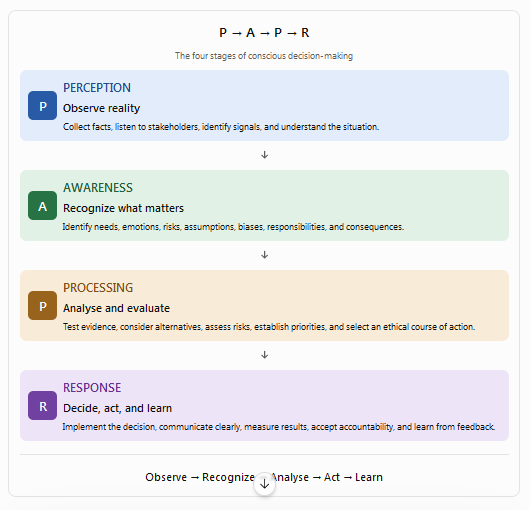
2. Applying PAPR across domains
A. Political decision making
- Perception: Understand constituency issues, public sentiment, political developments, and verified research.
- Awareness: Recognize community priorities, trust deficits, stakeholder expectations, and ethical obligations.
- Processing: Evaluate policy options, campaign performance, legal constraints, and resource allocation.
- Response: Develop an action plan, communicate responsibly, monitor implementation, and assess public outcomes.
B. Organizational management
- Perception: Gather operational data and employee feedback.
- Awareness: Identify organizational strengths, weaknesses, conflicts, and emerging risks.
- Processing: Compare strategic options, budgets, responsibilities, and likely outcomes.
- Response: Assign responsibilities, implement decisions, review performance, and improve systems.
C. Public service and governance
- Perception: Listen to citizens and identify service delivery gaps.
- Awareness: Recognize vulnerable groups, equity concerns, and local priorities.
- Processing: Assess feasibility, public benefit, costs, and legal requirements.
- Response: Deliver services, publish progress, resolve grievances, and measure impact.
D. Personal leadership development
- Perception: Observe situations and personal reactions.
- Awareness: Recognize emotions, habits, assumptions, and blind spots.
- Processing: Reflect on evidence, values, alternatives, and consequences.
- Response: Choose a considered action and learn from its results.
3. From a decision model to an organizational system
For use by PAPR in political research and consulting, the framework could be expanded into a repeatable advisory process:
1. Research and intelligence: Surveys, interviews, administrative data, field reports, and verified information.
2. Situational awareness: Stakeholder mapping, needs assessment, context, and risk identification.
3. Strategic analysis:Scenarios, alternatives, evidence assessment, and recommendations.
4. Implementation and accountability: Action plans, assigned responsibilities, performance indicators, audits, and feedback.
4. Result
PAPR is a practical, evidence-informed framework for developing conscious leadership and improving decision-making in political leadership, organizational management, and public service. By integrating observation, situational awareness, critical analysis, ethical judgment, and accountable action, the PAPR Model helps leaders understand complex situations, evaluate alternatives, make informed decisions, and continuously learn from outcomes.
